GMT
#4HumanScore 5.70MPJPE (rad) 0.158
Kinematic errors average frame-level pose differences, but often miss the physical artifacts that matter most in video: unstable support, foot skating, incorrect contact timing, and failed recoveries.
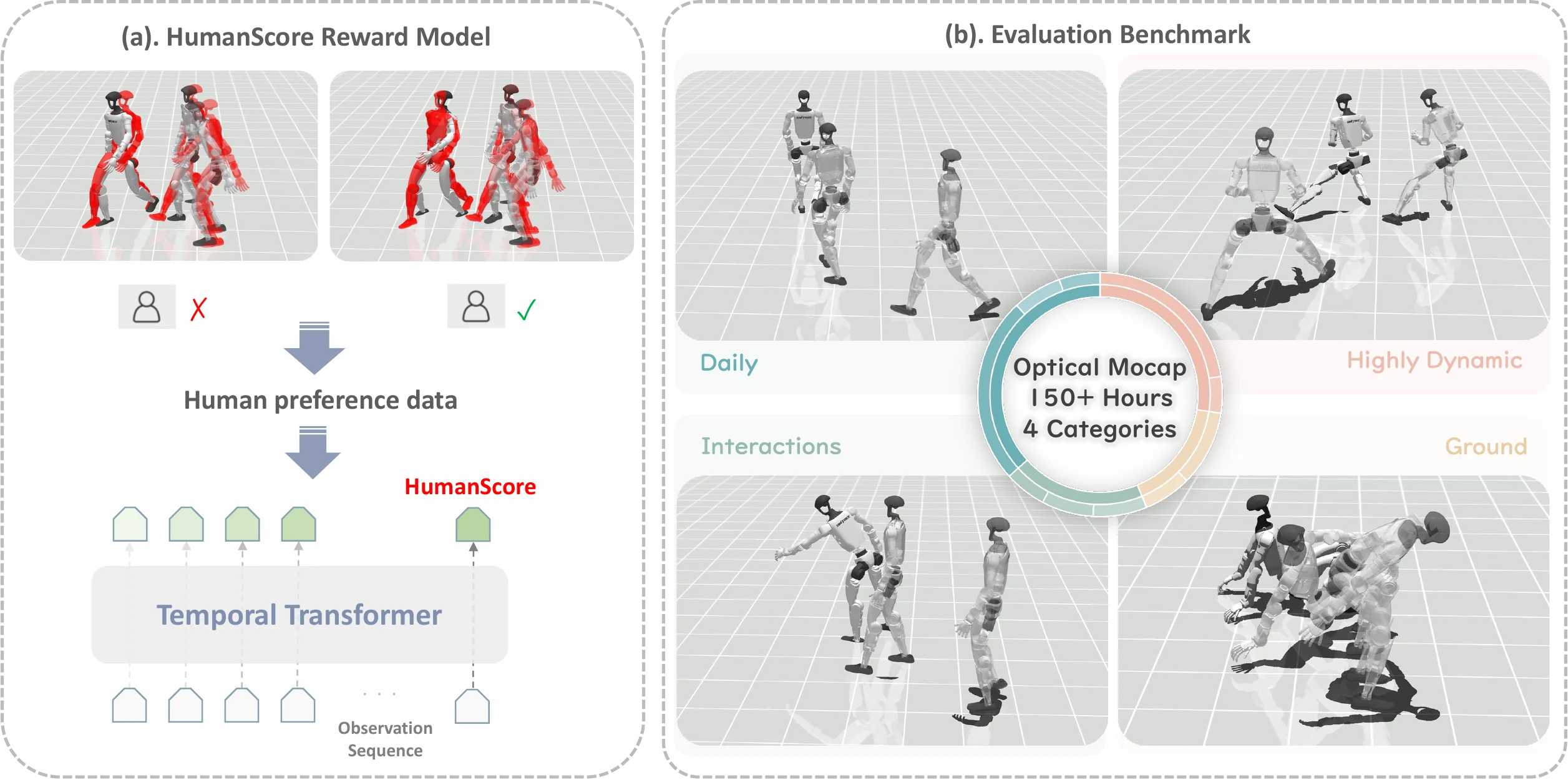
HumanTracker addresses both sides of evaluation. Its benchmark supplies broad, diagnostic motion coverage, while HumanScore learns trajectory-level quality from human preferences and predicts which rollout people prefer.
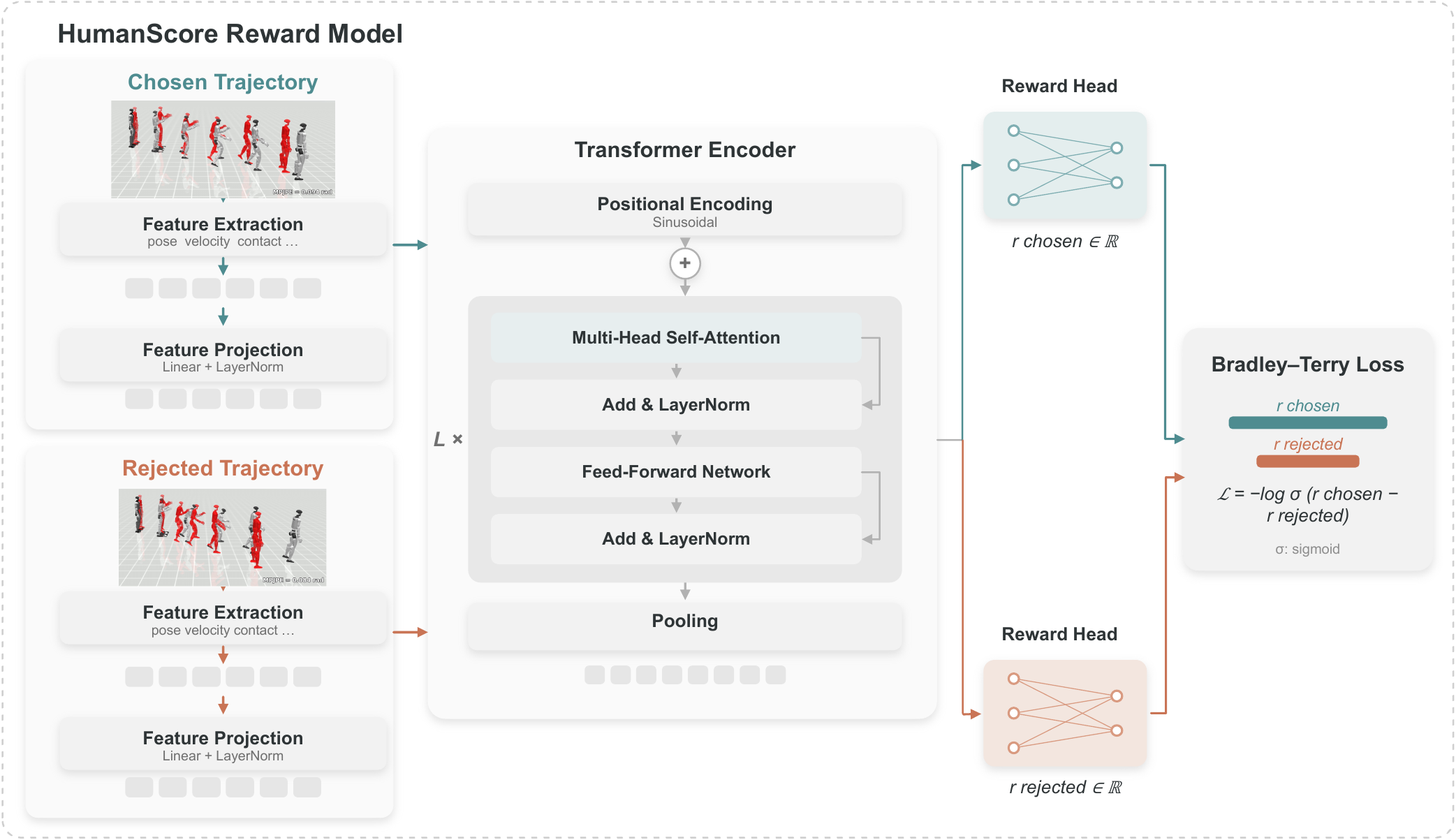
6,000 original pairs. Six expert annotators provide strict preferences, similar judgments, and cannot-compare judgments. Bilateral mirroring yields 12,000 preference records.
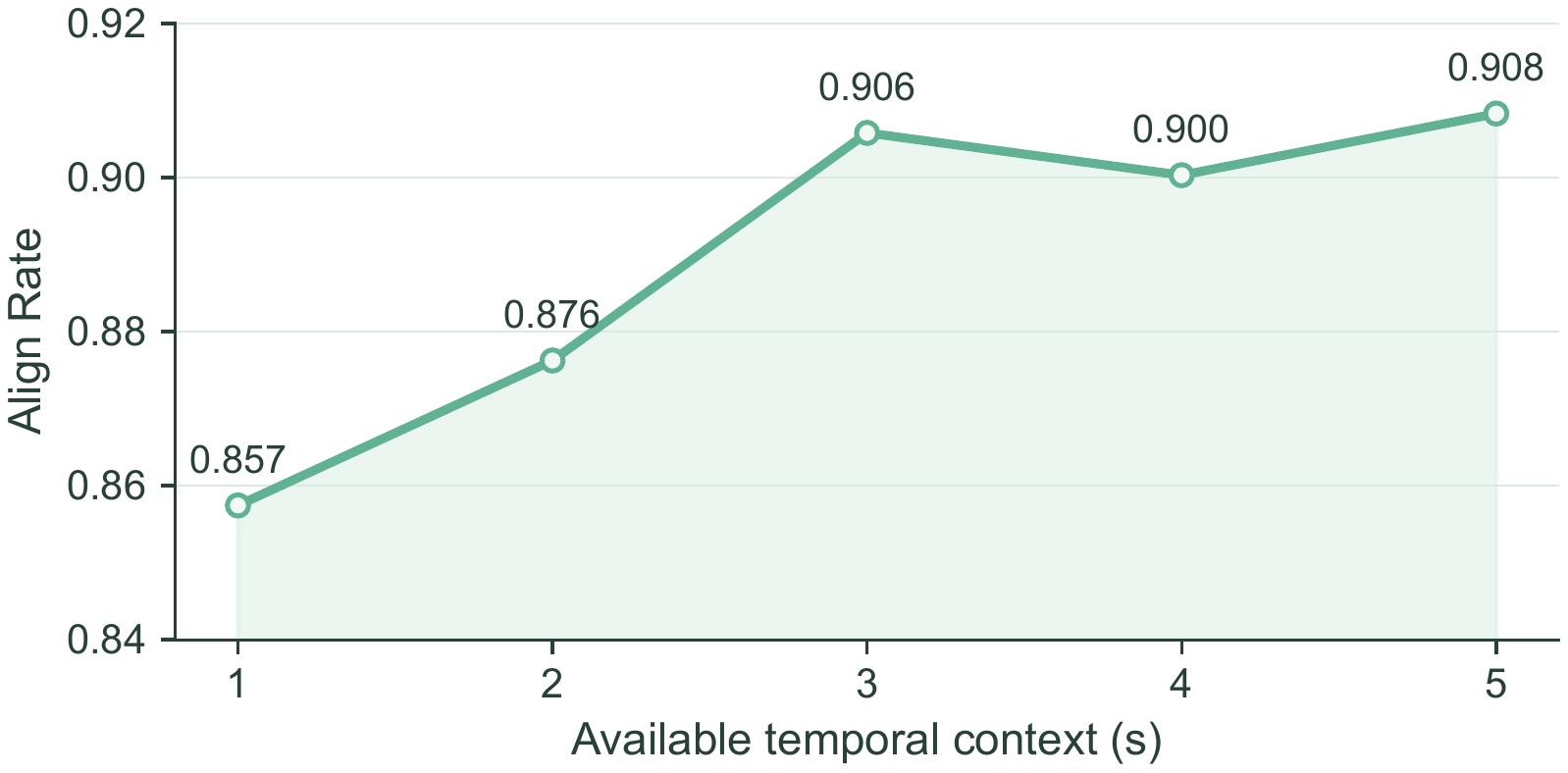
Five-second context. Each 250-frame window is encoded as a 539-dimensional frame-token sequence with explicit padding masks.
Readable output. Window rewards pass through a sigmoid and are averaged from 0 to 100, weighted by the number of actual frames.
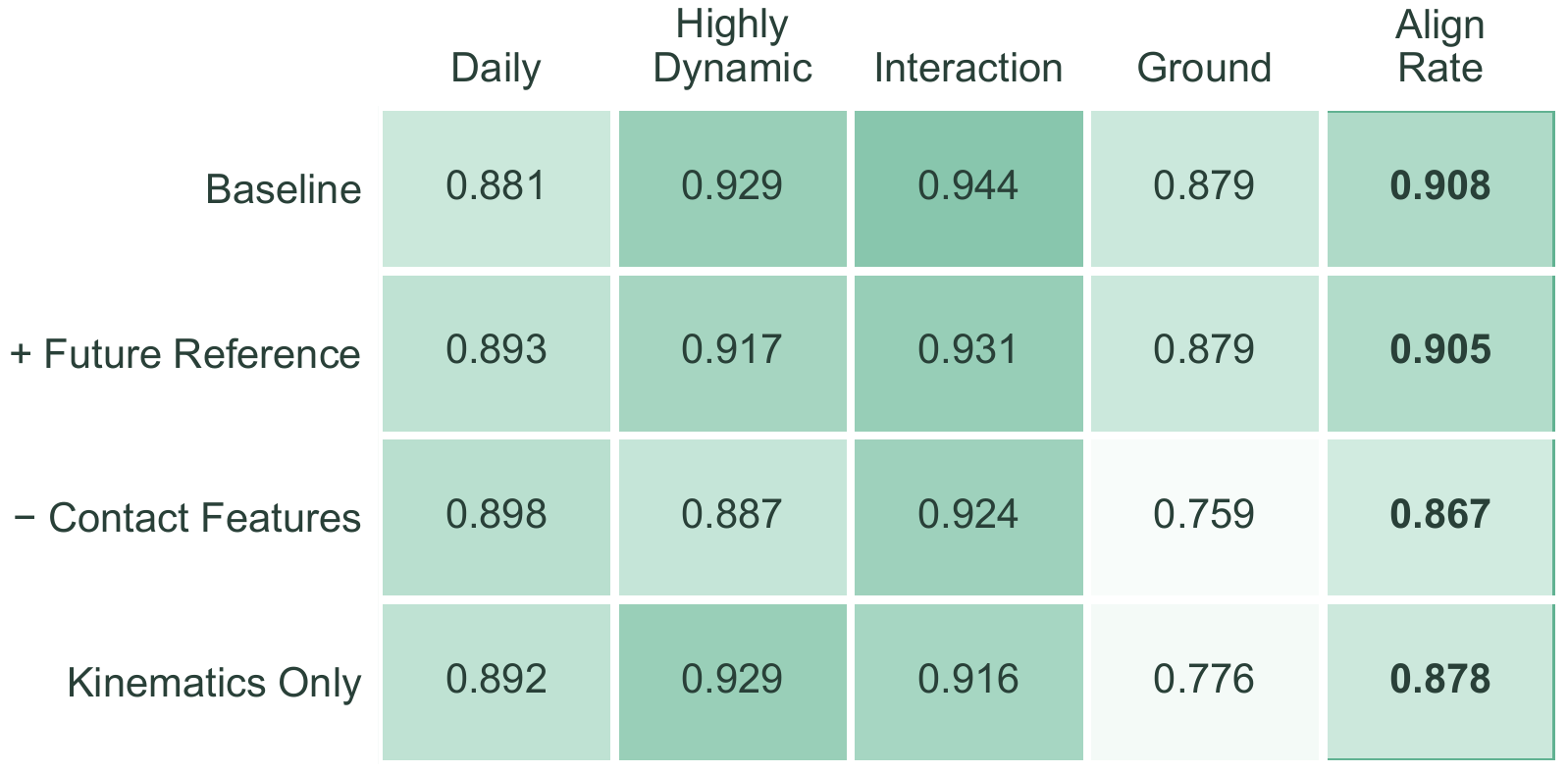
Family-balanced alignment rate (%) on original, unmirrored strict-preference comparisons from the motion-disjoint test set.
HumanScore 5.70MPJPE (rad) 0.158
HumanScore 86.75MPJPE (rad) 0.044
HumanScore 73.00MPJPE (rad) 0.103
HumanScore 24.37MPJPE (rad) 0.081
HumanScore 0.95MPJPE (rad) 0.155
HumanScore 82.29MPJPE (rad) 0.043
HumanScore 79.13MPJPE (rad) 0.075
HumanScore 23.11MPJPE (rad) 0.076
HumanScore 1.62MPJPE (rad) 0.166
HumanScore 79.72MPJPE (rad) 0.038
HumanScore 79.28MPJPE (rad) 0.060
HumanScore 5.83MPJPE (rad) 0.066
HumanScore 1.96MPJPE (rad) 0.107
HumanScore 33.04MPJPE (rad) 0.041
HumanScore 37.15MPJPE (rad) 0.105
HumanScore 20.18MPJPE (rad) 0.076
HumanScore 3.07MPJPE (rad) 0.447
HumanScore 63.32MPJPE (rad) 0.058
HumanScore 32.62MPJPE (rad) 0.206
HumanScore 9.39MPJPE (rad) 0.324
HumanScore 0.41MPJPE (rad) 0.246
HumanScore 39.46MPJPE (rad) 0.042
HumanScore 5.66MPJPE (rad) 0.151
HumanScore 0.65MPJPE (rad) 0.195
HumanScore 3.45MPJPE (rad) 0.121
HumanScore 84.48MPJPE (rad) 0.039
HumanScore 63.06MPJPE (rad) 0.071
HumanScore 31.60MPJPE (rad) 0.069
HumanScore 14.66MPJPE (rad) 0.107
HumanScore 76.04MPJPE (rad) 0.044
HumanScore 53.76MPJPE (rad) 0.087
HumanScore 71.83MPJPE (rad) 0.064
HumanScore 2.89MPJPE (rad) 0.111
HumanScore 79.92MPJPE (rad) 0.045
HumanScore 70.98MPJPE (rad) 0.061
HumanScore 18.59MPJPE (rad) 0.062
HumanScore 1.28MPJPE (rad) 0.345
HumanScore 13.23MPJPE (rad) 0.103
HumanScore 33.60MPJPE (rad) 0.242
HumanScore 0.12MPJPE (rad) 0.224
HumanScore 0.00MPJPE (rad) 0.552
HumanScore 45.71MPJPE (rad) 0.234
HumanScore 39.77MPJPE (rad) 0.197
HumanScore 0.00MPJPE (rad) 0.342
HumanScore 19.80MPJPE (rad) 0.302
HumanScore 24.08MPJPE (rad) 0.201
HumanScore 22.34MPJPE (rad) 0.118
HumanScore 35.10MPJPE (rad) 0.219
Every clip includes a family label, a natural-language description, a fitted SMPL sequence, and a robot-space reference trajectory.
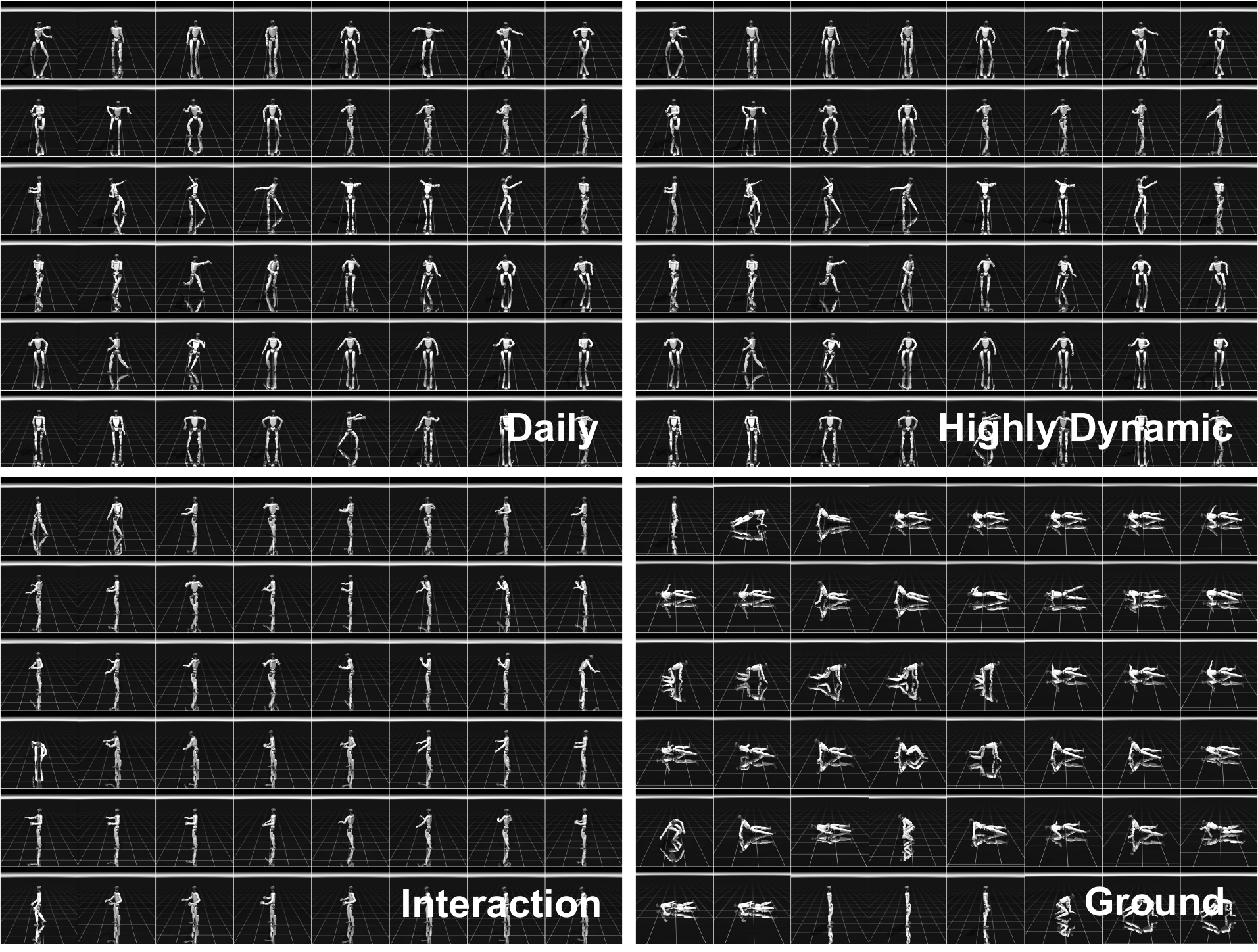
Steady locomotion, turning, and routine gestures reveal stability and residual drift.
Jumps, kicks, acrobatics, and fast footwork stress impact handling and phase timing.
Object and environment interactions require hand, arm, and whole-body coordination.
Low postures and multi-contact transitions test contact geometry, balance, and recovery.
Succ (%) ↑, MPJPE (rad) ↓, HumanScore ↑ on a 0–100 scale, computed on the test split. The GMT, TWIST2, SONIC, and Humanoid-GPT rows match Table 2 of the paper. SONIC 1.1 and nine additional released policies were evaluated under the same protocol.
| Method | Daily | Highly Dynamic | Interaction | Ground | ||||||||
|---|---|---|---|---|---|---|---|---|---|---|---|---|
| Succ | MPJPE | HScore | Succ | MPJPE | HScore | Succ | MPJPE | HScore | Succ | MPJPE | HScore | |
| GMT | 17.0 | 0.250 | 2.4 | 36.2 | 0.196 | 7.0 | 81.4 | 0.205 | 11.7 | 0.0 | 0.456 | 4.0 |
| TWIST2 | 60.1 | 0.105 | 10.1 | 39.9 | 0.112 | 16.9 | 91.3 | 0.111 | 28.3 | 0.0 | 0.341 | 4.5 |
| SONIC | 93.8 | 0.102 | 49.5 | 82.1 | 0.118 | 41.0 | 97.6 | 0.128 | 54.6 | 20.1 | 0.231 | 26.5 |
| SONIC 1.1 | 94.4 | 0.093 | 43.6 | 84.7 | 0.108 | 38.5 | 97.9 | 0.111 | 48.9 | 13.4 | 0.198 | 33.9 |
| Humanoid-GPT | 94.4 | 0.046 | 54.7 | 86.9 | 0.047 | 49.2 | 97.2 | 0.070 | 56.8 | 32.9 | 0.216 | 24.9 |
| ScaleBFM-M | 90.8 | 0.094 | 44.5 | 72.4 | 0.091 | 39.3 | 96.5 | 0.084 | 54.0 | 17.7 | 0.186 | 43.4 |
| HEFT | 93.2 | 0.056 | 46.1 | 75.7 | 0.061 | 40.5 | 97.5 | 0.063 | 51.6 | 15.9 | 0.176 | 31.7 |
| ScaleBFM-XL | 90.1 | 0.093 | 44.2 | 74.3 | 0.089 | 37.5 | 96.7 | 0.082 | 51.2 | 17.1 | 0.158 | 40.8 |
| GRIT v0.0.1 | 90.2 | 0.105 | 40.2 | 65.7 | 0.115 | 41.4 | 96.5 | 0.114 | 48.5 | 11.0 | 0.241 | 24.9 |
| TeleopIT | 84.0 | 0.096 | 34.0 | 54.9 | 0.110 | 35.8 | 96.2 | 0.105 | 45.7 | 13.4 | 0.229 | 47.1 |
| MimicLite-PPO | 81.1 | 0.080 | 28.0 | 58.6 | 0.096 | 28.1 | 95.2 | 0.089 | 37.9 | 7.9 | 0.239 | 20.1 |
| MimicLite-ROA | 83.1 | 0.080 | 24.8 | 59.0 | 0.112 | 26.9 | 95.2 | 0.093 | 35.1 | 2.4 | 0.290 | 26.6 |
| HoloMotion | 84.0 | 0.088 | 20.4 | 63.4 | 0.101 | 27.2 | 94.9 | 0.091 | 40.4 | 18.3 | 0.172 | 35.1 |
| Mimic Lite v1.1 | 80.1 | 0.080 | 25.0 | 51.5 | 0.114 | 22.8 | 94.4 | 0.087 | 34.3 | 7.3 | 0.252 | 23.1 |
Every tracker keeps its native observation and action-processing stack, receives the same retargeted references, and is measured by the same evaluator under the SONIC termination criterion.
It summarizes trajectory-level preference over contact, stability, smoothness, and reference fidelity. Higher is better within the same evaluation setting.
A rollout may look accurate before an early failure. Success prevents a short failed trajectory from being mistaken for robust tracking.
MPJPE and related errors remain useful for locating specific problems; HumanScore is not a replacement for every analytic diagnostic.
@misc{liu2026humantrackercomprehensivehumanalignedmotion,
  title         = {HumanTracker: Towards Comprehensive and Human-Aligned
                   Motion Tracking Benchmark},
  author        = {Dairu Liu and Zekun Qi and Jiayu Zeng and Ruixi Yu and
                   Yu Guan and Yintianrun Zhang and Xuchuan Chen and
                   Sikai Liang and Zekai Li and Chenghuai Lin and
                   Xinqiang Yu and Wenyao Zhang and He Wang and Li Yi},
  year          = {2026},
  eprint        = {2608.13555},
  archivePrefix = {arXiv},
  primaryClass  = {cs.RO},
  url           = {https://arxiv.org/abs/2608.13555}
}